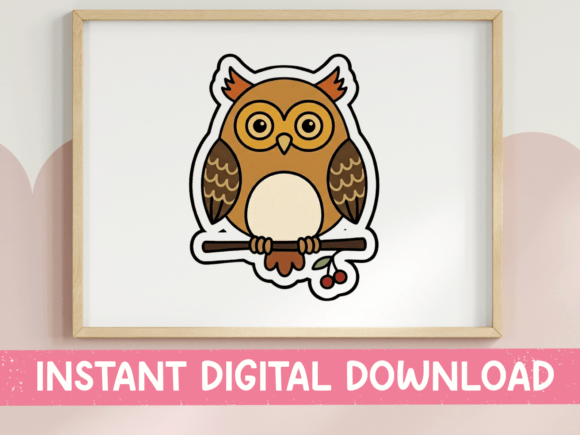
Brown Owl on Branch Sticker Design
A Warm, Whimsical Anchor for Handmade Projects
First glance at the Brown Owl on Branch Sticker Design feels like spotting a quiet moment in a sun-dappled forest—soft, grounded, and gently inviting. It’s not a bold or graphic statement; it’s a cozy pause. The plump, round silhouette reads instantly, even at small scales, and the warm brown, caramel, and cream tones suggest earthiness without heaviness. That thin branch with tiny red berries adds just enough narrative detail—enough to spark recognition, not so much that it overwhelms. As an embroidery designer who’s stitched hundreds of woodland motifs, I immediately pictured this on a linen tea towel for a local boutique, or centered on a cotton baby onesie as a gentle nursery accent. Its visual personality leans into calm authenticity—not cartoonish, not overly refined—making it ideal for handmade product lines where warmth and intention matter more than flash.
Where This Design Shines in Real Embroidery Work
I tested the Brown Owl on Branch Sticker Design across several real-world applications: a medium-weight organic cotton tote bag, a loopback cotton sweatshirt, and a 100% cotton kitchen towel. On all three, it held up beautifully—especially when paired with quality stabilizer and careful thread color selection. The owl’s rounded form translates well into satin stitch outlines and smooth fill stitch bodies, while the branch and berries lend themselves naturally to fine running stitch accents. As a tote bag design, it added charm without competing with the fabric’s texture. On the sweatshirt, the low-to-moderate stitch density kept the embroidery supple—no stiffening or puckering around the wings or branch. And on the tea towel? It read clearly from across the room, even after a test wash. For Etsy sellers and craft fair vendors, this is exactly the kind of handmade product detail that builds trust: recognizable, well-proportioned, and emotionally resonant.
Thoughtful Pairings for Commercial & Personal Use
- Custom apparel: Works especially well on crewneck sweatshirts, relaxed-fit tees, and unisex aprons—its scale and shape flatter casual silhouettes.
- Baby embroidery: Gentle tones and soft edges make it ideal for onesies, burp cloths, and nursery pillows—no sharp angles or fussy details to snag delicate skin.
- Holiday embroidery: Swap the berries for subtle gold thread or pair it with cinnamon-toned fabric for autumn gifting—it reads seasonally without needing reinvention.
- Embroidered patch: Clean outer contour means it patches cleanly onto denim jackets or canvas backpacks with minimal fraying risk.
- Digital embroidery file: Its balanced composition makes it highly effective in printable mockups—clients instantly “get” the vibe, which shortens revision cycles.
Where to Proceed With Care
The Brown Owl on Branch Sticker Design isn’t built for every surface—and that’s okay. Its charm lies in its specificity. Avoid using it on fabrics with heavy texture (like bouclé or thick terry) unless you increase stabilizer layers significantly—the tiny berries may disappear into the pile. On stretchy knits, stabilize aggressively and consider simplifying the berry detail manually if your machine struggles with tight curves at small scale. It also doesn’t translate well to ultra-small hoop sizes (under 3 inches) without losing definition in the branch tip or eye detail. And while it’s lovely on dark fabric, test contrast carefully: cream thread on charcoal can mute the warmth. For curved surfaces like caps, position it toward the front panel—not the crown—where the branch’s horizontal line stays legible. If you’re planning layered garments (e.g., embroidery over lace or mesh), confirm the design’s stitch density won’t cause shadowing or stiffness.
Design Integrity Meets Customer Perception
What stands out about the Brown Owl on Branch Sticker Design is how it elevates perceived value without demanding premium pricing. Customers notice the thoughtful color harmony, the intentional spacing between owl and branch, the way the berries sit *on* rather than *in* the branch—subtle cues that signal care in creation. That directly supports brand consistency for small shop owners and boosts buyer engagement: people don’t just buy an owl—they buy a mood, a story, a piece of quiet confidence. In personalized gift contexts—say, a custom embroidered pillow cover for a new parent—the design feels intentional, not generic. It avoids cliché while staying accessible. That balance is rare. For commercial embroidery work, it holds up under repeated production because its structure is forgiving: no micro-details that unravel, no dense fills that trap lint, no overlapping elements that confuse auto-digitizing software.
Practical Designer Notes Before You Stitch
- Always run a test on scrap fabric matching your final substrate—especially for thread tension and stabilizer pairing.
- Review thread colors against both light and dark backgrounds; warm browns behave differently on ivory vs. navy.
- Inspect the smallest elements—the berry highlights and eye shape—under magnification before finalizing.
- Use a medium-cutaway or tear-away stabilizer depending on fabric weight; skip lightweight cut-aways on baby items.
- Check licensing terms before selling finished products or bundling the digital embroidery file with other design assets.
- Try a black-and-white mockup—if the shape reads clearly without color, your embroidery will too.
- Confirm whether the machine embroidery design includes optional applique versions; sometimes a fused base layer improves dimension on textured fabrics.